
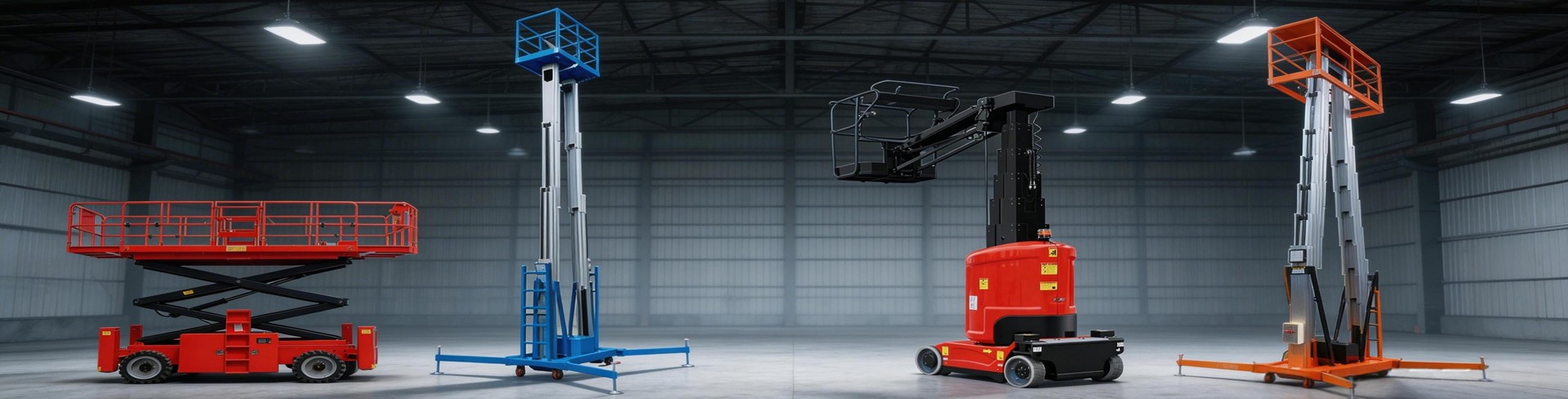
Telescopic boom lifts are widely used vertical material transportation equipment, featuring compact structure, strong load-bearing capacity and smooth operation. They are widely applied in industrial manufacturing, warehousing and logistics, workshop distribution, automated high-rise warehouses and other scenarios. The operational performance of the equipment is not only influenced by mechanical, electrical and hydraulic systems, but also closely related to external environmental conditions. Among them, ambient temperature is one of the key factors affecting the operational stability, service life and safety performance of the equipment.
The performance of the hydraulic system is significantly affected by temperature changes. The hydraulic system is the core power source of telescopic boom lifts. High or low temperatures directly affect the viscosity of hydraulic oil and the response speed of the system. In low-temperature conditions, the viscosity of hydraulic oil increases, its fluidity decreases, and the starting resistance of the oil pump increases, which may lead to difficulties in system startup, slow startup or even failure to start. High viscosity can also cause an increase in hydraulic pipeline pressure, easily leading to oil pipe rupture and seal ring damage, and shortening the service life of hydraulic components. In high-temperature environments, the viscosity of hydraulic oil decreases, and its lubrication performance declines, which can easily cause an increase in internal leakage, a decrease in cylinder thrust and a reduction in lifting capacity. Long-term high temperatures can accelerate the oxidation of hydraulic oil, forming sludge and deposits, blocking valve bodies and oil return circuits, and affecting the system's response and control accuracy. In extremely high-temperature environments, the aging speed of seals in the oil cylinder will accelerate, leading to seal failure, oil leakage or unstable system pressure.
The stability of the electrical control system decreases under abnormal temperatures. The electrical control system is sensitive to temperature changes, which directly affects the control accuracy and safety protection capability of the entire machine. In low-temperature conditions, the response time of certain electrical components such as contactors, relays and sensors slows down, and startup delays or failures may occur. Low temperatures can cause a decrease in the capacity of battery-type components, and the control system may restart or lose control due to insufficient voltage. In high-temperature environments, the internal temperature of the electrical control cabinet increases, which may cause components such as PLCs, inverters and power modules to overheat, frequently alarm, operate at reduced frequencies or shut down due to faults. Long-term high-temperature operation can cause the insulation layer of cables to age, terminal blocks to oxidize and loosen, increasing the risk of electrical short circuits or fires. In high-temperature and high-humidity environments, control boards are prone to condensation or moisture absorption, leading to corrosion of circuit boards or short circuits, affecting the stability of the control system.
The risk of mechanical structure deformation increases under extreme temperature conditions. The thermal expansion and contraction effect of mechanical components is more significant under extreme temperature conditions, which has a certain impact on the overall structure of the equipment. In high-temperature conditions, the expansion of metal structures such as guide rails, platforms and fork arms may lead to a decrease in guiding accuracy and cause slight jamming or vibration during platform operation. In extremely low environments, metals become brittle and their impact resistance decreases. When subjected to instantaneous loads, microcracks or weld cracks may occur. Components made of different materials (such as steel structures and rubber components) have different thermal expansion coefficients, and temperature changes can cause loosening of connections or failure of preload. Platforms exposed to high temperatures for a long time are prone to coating aging and color changes, thereby reducing the appearance and corrosion resistance of the equipment.
The efficiency of the lubrication system is significantly affected by temperature. The protection of moving parts by the lubrication system depends on the fluidity and adhesion of the lubricant, and these two indicators are strongly influenced by temperature fluctuations. In low-temperature conditions, the viscosity of lubricating oil increases, and the friction resistance between moving parts such as bearings and slides increases, resulting in significant startup wear. In high-temperature conditions, lubricating oil is prone to loss or evaporation, forming a dry friction state, which aggravates component wear and shortens service life. In high-temperature conditions, lubricating grease is prone to emulsification or decomposition, forming deposits that block lubrication channels and leading to lubrication failure. In environments with frequent alternation between cold and hot, the oxidation of lubricating oil accelerates. It is recommended to use industrial-grade lubricating oil with temperature resistance.