
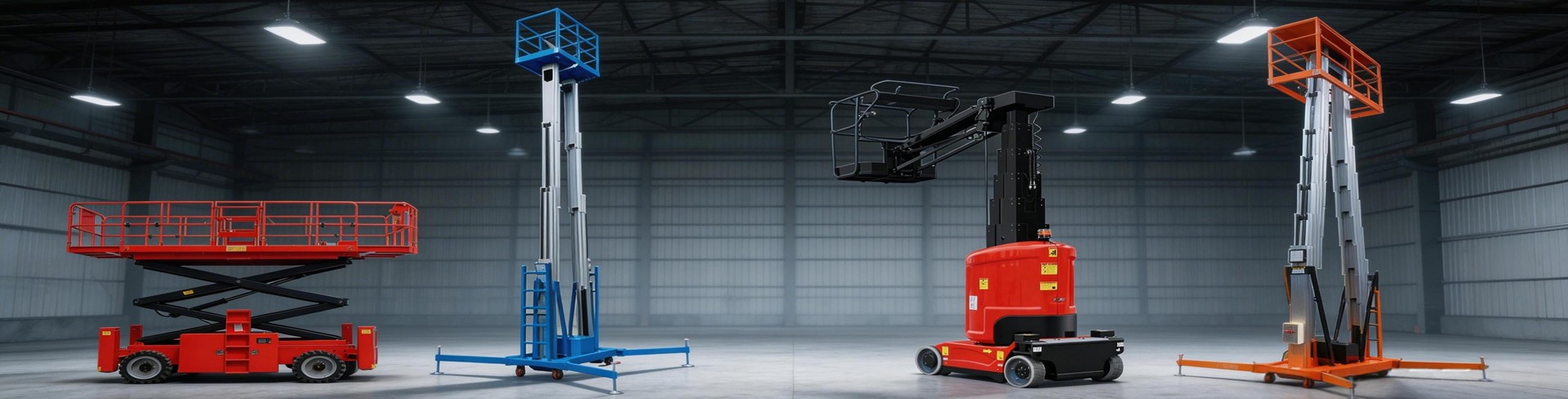
Safety is the top priority in high-altitude operations. Although mini electric scissor lifts are compact and easy to operate, they require an integrated intelligent safety system when used in narrow indoor spaces or crowded areas.
Automatic Pit Protection System: When the platform rises, the protective plates on both sides of the chassis automatically extend to reduce the ground clearance. If the equipment encounters a pit, the plates will provide support to prevent tipping.
Tilt Sensor and Alarm: To prevent instability during high-altitude driving, the equipment is equipped with a tilt sensor. If the ground slope exceeds the safety limit (usually 1.5 to 3 degrees), the lifting function will be locked, and an alarm will sound.
Load Sensing and Overload Limit: Precision pressure sensors monitor the platform load in real time. If the rated load capacity (e.g., 240 kilograms) is exceeded, the system will cut off the power supply to the lifting function.
Emergency Lowering Device: In the event of a power failure or battery failure, the manual release valve at the bottom of the chassis allows the operator to safely lower the platform to the ground without external assistance.
Frequently Asked Questions about Mini Electric Scissor Lifts
Q: What is the charging cycle and battery life of a mini electric scissor lift?
A: Most models are charged using a standard 220V indoor socket. A 6-8 hour charge can support intermittent and frequent operation throughout a full working day (about 6-8 hours).
Q: Can these devices fit into standard passenger elevators in office buildings?
A: Yes, this is a highlight of the mini electric scissor lift design. Their width is typically around 760 millimeters, and their weight is between 600 and 1200 kilograms, meeting the size and load requirements of most commercial elevators.
Q: Do you need a special driver's license to operate a mini electric scissor lift?
A: Although a standard driver's license is not required, operators must undergo specific safety training (such as IPAF certification or local certification) to understand the equipment's limitations and emergency procedures.
Q: Are the maintenance costs high?
A: Compared to fuel-powered equipment, maintenance costs are very low. Without an engine or complex transmission, the main maintenance includes checking the hydraulic oil level, cleaning the battery, and lubricating the points.
Q: How do the non-marking tires perform on wet or oily surfaces?
A: The non-marking tires on mini electric scissor lifts are high-friction solid rubber, designed for dry indoor floors. On wet or oily surfaces, traction is reduced; the speed should be reduced, and the floor should be kept as dry as possible to prevent slipping.