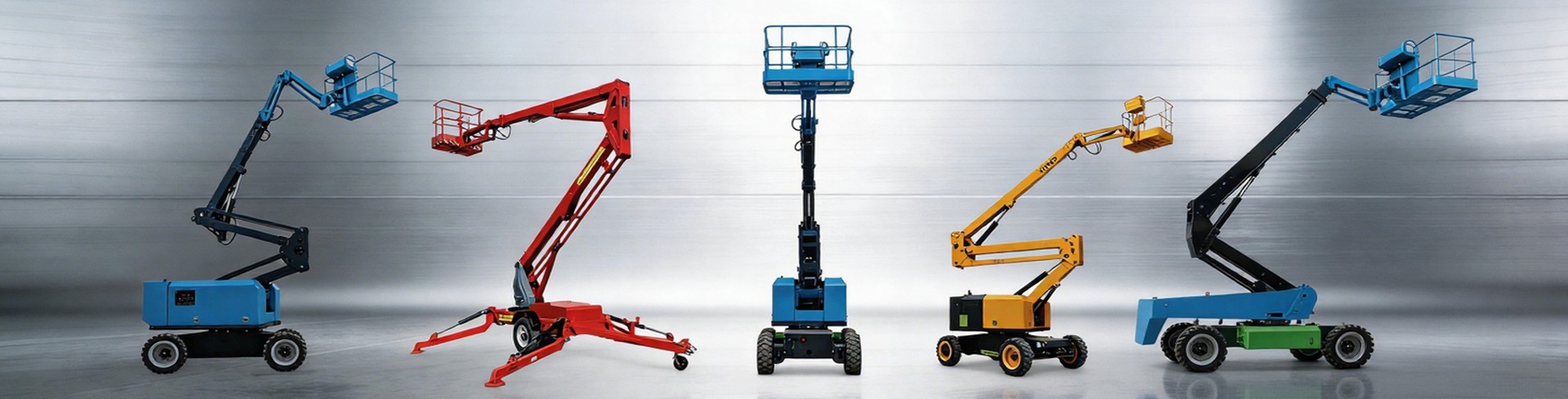
Aerial work platforms play a critical role in modern construction, maintenance, and renovation projects. To ensure the safety of operators, these platforms are equipped with multiple safety devices, among which the emergency descent system is a core component. This system is designed to safely and quickly lower the work platform and its occupants to the ground in the event of a power failure, hydraulic loss, or other emergency situations.
Design Principles of the Emergency Descent System
The emergency descent system is built on a redundant safety design philosophy, with the core goal of ensuring controlled, stable platform lowering under abnormal conditions (such as hydraulic pressure loss, power failure, or operational error). Modern systems integrate multiple protective measures, including anti-fall valves and shock absorbers, to achieve reliable emergency load unloading.
Key Components and Structure
The emergency descent system consists of the following key parts:
• Emergency operating handle: Usually mounted on the drive platform or platform side, allowing operators to manually initiate the emergency descent procedure.
• Hydraulic emergency circuit: Independent of the main hydraulic system, the platform’s descent speed is precisely controlled via dedicated oil lines and control valves.
• Anti-fall device: Prevents uncontrolled platform descent through mechanical locking mechanisms or hydraulic check valves.
• Buffer device: Uses hydraulic damping or spring buffers to ensure smooth deceleration and reduce impact during descent.
• Electrical interlock system: Ensures synchronized response of related electrical systems to avoid misoperation during emergency activation.
Our products adopt an advanced dual hydraulic circuit design, so even if the main hydraulic loop fails, the emergency circuit can operate independently, greatly improving system redundancy and safety.
Working Principle and Operation Process
The operation of the emergency descent system includes three main stages: activation, controlled descent, and stop.
• Activation: When the main power system fails or a dangerous situation occurs, the operator pulls the emergency operating handle to activate the system.
• Controlled descent: The hydraulic emergency circuit or gravity drive connects the oil flow, controlling the platform to lower slowly. The anti-fall device activates during descent to prevent runaway, while the buffer device absorbs impact.
• Stop: Once the platform lands safely, the emergency system automatically disconnects. The main power system can only be restarted after safety is confirmed.
Product Advantages and Innovative Functions
• Multiple redundant safeguards: Dual hydraulic circuits run independently, ensuring stable descent even in extreme scenarios.
• Intelligent fault diagnosis: Built-in sensors monitor hydraulic pressure, motor status, and anti-fall lock status in real time, automatically alerting and logging data for troubleshooting.
• Ergonomic design: The emergency handle conforms to ergonomics, with clear visual indicators and audio prompts for quick activation.
• Optimized buffer system: Multi-stage hydraulic damping and spring buffering minimize impact, protecting operator safety.
• Modular compatibility: The system is compatible with scissor lift, boom lift, aluminum mast lift, and telescopic mast lift, adapting to diverse customer needs and working environments.
News